
Mastering Your State Farm Policy on the iPad
If your insurance lives on a laptop and a stack of paper, the State Farm app on an iPad is a quietly useful upgrade. We spent a couple of weeks running our own auto and renters policies through it on an iPad Air, and the short version is this: it does the everyday jobs well, the big screen makes your documents easy to actually read, and a few corners still feel like a phone app stretched to fit. The good news for 2026 is that the App Store listing supports iPad directly, so you are not sideloading anything odd. Here is how to get it set up and what genuinely matters once you are in.
Getting the app running smoothly on your iPad
There is no separate iPad-only build in the App Store, so you install the same State Farm app you would on an iPhone. It is published by State Farm Mutual Automobile Insurance Company, and the current listing supports iPadOS 17.0 or later, so most iPads sold in the last several years will run it without complaint. Search for State Farm, tap Get, and once it lands on your Home Screen the layout scales to fill the iPad display. On our test tablet it opened in full screen rather than a tiny phone-sized window, which was a relief, though you will notice the design was clearly drawn for a taller, narrower phone first.
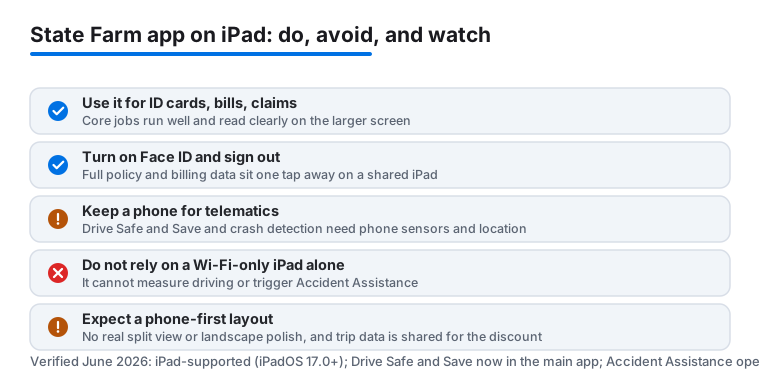
Sign in with the same State Farm account you use on the web. If you have never made one, you can register inside the app using your policy number or the email on file. We suggest turning on Face ID the moment it offers, because typing a long password on the glass keyboard every time gets old fast. In our testing the first login took close to a minute to pull every policy into view, and after that it remembered us instantly. One practical tip: if you share an Apple Account across a family iPad, sign out when you are done, since your full policy and billing details sit one tap away once you are in.
A word on accounts you may have carried over from years past. State Farm used to ship a separate Drive Safe and Save app for telematics, but that has been folded into the one main app, so do not go hunting for a second download. If you still have the old standalone app on an older device, it is no longer the place to manage anything; everything now lives in the single State Farm app described here. Delete the leftover one to avoid confusion.
Before you lean on the iPad for anything time-sensitive, do a quick check that your policies actually appear. The app mirrors whatever your agent and State Farm's records hold, so if a vehicle is missing or an address looks stale, that is a records issue to raise with your agent, not a bug in the app. Catching it on a calm afternoon beats discovering it at a claim moment.
The features that actually earn their place
Most people open an insurance app for a handful of reasons, and the State Farm app covers the important ones without making you dig. These are the parts we reached for again and again:
- Digital ID cards. Your auto insurance cards live under your vehicle, and on the iPad they are large and crisp enough to hand the screen to an officer or a body shop. You can also email them or save them as a PDF in seconds. Worth knowing: a digital card is accepted in most states, but a few still expect a paper copy, so keep a printed one in the glove box as backup.
- Bill pay and autopay. Viewing your balance, paying a premium, or switching on automatic payments all worked cleanly. The bigger screen makes payment history far easier to scan than on a phone, and you can see exactly which policy a charge belongs to.
- Filing and tracking claims. You can start an auto, property, or vehicle glass claim, add photos and documents, and follow the status through each step with notifications. Snapping damage photos with the iPad camera is awkward in a parking lot, but reviewing an open claim on the couch is genuinely pleasant.
- Roadside assistance. A few taps requests a tow or a jump and shares your location. We did not need a real rescue during testing, but the request flow was clear, and it tells you what your policy covers before you commit.
Two newer pieces are worth calling out. Drive Safe and Save, the program that can lower your auto rate based on how you drive, is now managed inside this same app, with streaks and trends so you can see whether your habits are improving. And Accident Assistance, State Farm's crash detection and response feature, expanded in 2026: as of March 16, 2026, it is available to all State Farm app users with an eligible auto policy and no longer requires Drive Safe and Save enrollment. When a crash is detected, the app gives you about sixty seconds to respond before it can follow up with a call and help start a claim. Both of those features lean on a phone's sensors and location, which leads straight into the next point.
Practical tips that made it better in daily use
A few small habits turned the app from fine into genuinely handy. First, save your ID cards to the Files app ahead of time so you can pull them up even with no signal in a parking garage. We were glad we did this before a road trip rather than fumbling for it later. The export lives right on the ID card screen, so it takes about ten seconds per vehicle.
Second, if you check balances often, keep the app one swipe away rather than buried in a folder; the payment summary loads fast enough that a quick glance answers most questions. Third, if you hold more than one policy, take a minute to confirm each vehicle and property is listed correctly under your account, because the app simply reflects whatever State Farm has on record. We caught an outdated address this way in about thirty seconds, which would have been a headache at renewal.
Fourth, keep your agent's contact card handy inside the app. For anything the self-service tools cannot answer, tapping straight through to call or message your local agent was faster than hunting for a number on the website. And fifth, if you plan to rely on Drive Safe and Save or Accident Assistance, set those up on the iPhone that actually rides with you, then use the iPad to review the results. The iPad is a fine reading screen for trip history and savings; it is not the device that should be measuring your driving.
Where it falls short and the limits to expect
Honesty matters here, so a few things tempered our enthusiasm. The biggest is that this is fundamentally a phone-first app running on a tablet. Buttons and headers sometimes sit with too much empty space around them, and there is no real split-view multitasking or proper landscape polish, so reading sideways feels like an afterthought. It works, it just does not feel built for the iPad the way Apple's own apps do.
You will also still need a phone for the parts that depend on hardware. Drive Safe and Save trip logging, crash detection, and any feature leaning on cellular location and motion sensors are happiest on an iPhone that travels with you. A Wi-Fi-only iPad parked at home cannot measure your driving, so treat the tablet as a comfortable companion screen rather than your sole device. We also hit the occasional loading spinner during busy evening hours, and a couple of deeper account changes nudged us out to a browser or to the agent.
On privacy and cost, two honest caveats. The app and its core features are free, but Drive Safe and Save shares trip and location data with State Farm to calculate your rate, and how much you save depends on your actual driving, not a guaranteed discount. If location tracking bothers you, you can decline that program and still use the rest of the app normally. Also keep in mind that anyone holding your unlocked iPad can see your full policy, billing, and personal details, which is exactly why the Face ID and sign-out advice above matters. None of this is a dealbreaker, but if you hoped to run your entire insurance life from the tablet alone, set expectations accordingly. For broader picks beyond insurance, our roundup of the best finance apps for iPad is a good next stop.
Good alternatives and how it compares
If you are weighing the State Farm app against the rest of your financial toolkit, it helps to know what sits nearby. State Farm does one job, your insurance, and does it cleanly, so it is not really competing with full banking apps. Still, the same tablet that holds your policy probably holds the apps where your money actually moves, and the gap in polish is noticeable. Banking apps tend to feel more finished on iPad, which is worth keeping in mind if a tidy layout matters to you.
For day-to-day banking on the same iPad, we found Chase well built and feature rich, and you can read our take in what makes the Chase app stand out. If you bank with Truist, our guide to managing your finances with the Truist iPad app covers similar ground. And if you simply want to browse more options across the category, the full Finance app hub lists what we have tested. The honest takeaway: keep the State Farm app for what it is best at, your cards, bills, and claims, and lean on a dedicated banking app for everything else. If you carry a different insurer, the same logic holds; the app from your own company will almost always beat a third-party tool for the day-to-day jobs.
FAQ
Is there a dedicated State Farm app made for the iPad?
There is no iPad-only version, but the regular State Farm app does support iPad. You install the same app from the App Store that runs on an iPhone, and on iPadOS 17.0 or later it scales up to fill the screen. Everyday tasks work well, though the layout was designed for a phone first, so it lacks split-view multitasking and true landscape polish.
Can I show my insurance ID card from the iPad?
Yes, and it is one of the app's better uses. Your auto ID cards sit under each vehicle and display large and clear on the iPad. We recommend saving a copy to the Files app ahead of time so you can pull it up even without a signal, and keeping a paper card in the car too, since a few states still ask for one.
Will Drive Safe and Save work if I only use an iPad?
Not for the tracking. You can view your Drive Safe and Save details, streaks, and trends in the app, but the actual trip measurement that affects your rate relies on a phone with motion sensors and location. The same goes for the Accident Assistance crash detection feature. Think of the iPad as a second screen for your account, not the device doing the driving measurement.
Is it safe to keep the app on a shared family iPad?
It can be, as long as you turn on Face ID and sign out when you finish. Your full policy, billing, and personal details are only a tap away once you are logged in, so on a tablet several people use, locking it behind Face ID and ending your session is the sensible move. The app itself is free, but treat the account data inside it as you would any banking app.