
iPhone TikTok Editing Hacks: From First Clip to Clean Cuts on iPhone and iPad
The first time you open the TikTok editor it can feel like a wall of tiny icons, and most people give up and post the raw clip. After weeks of editing short videos on both an iPhone and an iPad, we found the in app tools are genuinely good once you know where they hide. This guide walks you through getting set up, the features worth your time, the tricks that make edits look intentional, and where TikTok falls short so you know when to reach for something else.
Getting TikTok running and ready to edit
TikTok is a free download from the App Store and it runs on any iPhone or iPad that is on a reasonably current version of iOS or iPadOS. There is no Mac app, so editing happens on your phone or tablet, and what we describe here is all touch driven. The install itself is quick, but the editor leans on a few permissions that trip people up. The first time you tap the plus button to record, iOS asks for camera and microphone access, and it will also ask for photo library access the moment you try to import existing footage. If you tap Don't Allow in a hurry, the editor quietly disables the matching tools and gives no obvious warning, so you end up wondering why the upload button does nothing. The fix is to open Settings, scroll to TikTok, and switch the permissions back on yourself.
One thing worth knowing about photo access: iOS lets you grant your full library or just selected videos. If you pick selected videos and later cannot find a clip in the importer, that is why; go back into Settings and add the clip or switch to full access.
In our testing the editing screen behaved almost identically on iPhone and iPad, with one nice bonus. The larger iPad canvas makes dragging clips on the timeline far more precise, which matters once your edit has more than a handful of cuts. If you plan to do anything beyond a single take, tap the plus button, record or upload your clips, and then move into the editor rather than posting straight from the camera. That keeps your raw footage and your edits separate, so a fumbled cut never costs you the original. The app also saves a draft automatically as you go, but do not rely on that alone for a long session; we explain why below.
The editing features that actually matter
TikTok bundles a lot of tools, and the layout shifts a little with each update, but only a few earn regular use. As of mid 2026 these are the ones we reach for on almost every video, with the menu paths as they currently sit:
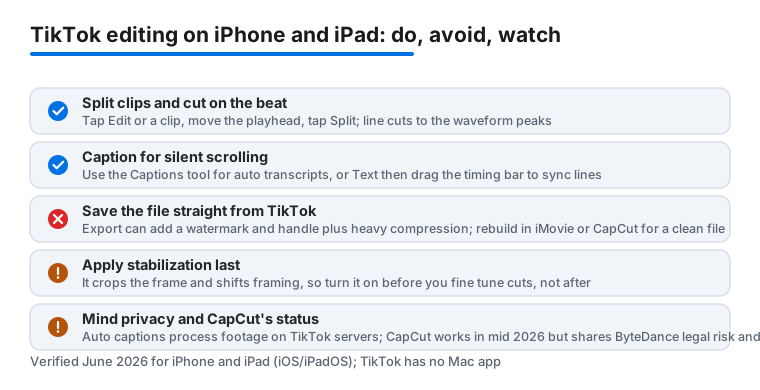
- Adjust clips: tap a clip on the timeline, or tap Edit at the bottom of the screen, to open the clip controls. From there you can trim the in and out points by dragging the handles, change the clip speed, or move the playhead and tap Split to cut a clip in two. Splitting a long take and deleting the dead air between the useful bits is the single fastest way to make a video feel tighter.
- Sync to sound: after you add a track, the editor shows the audio waveform under your clips. Lining up a cut with a visible peak is far easier than guessing, and it is the trick that makes amateur edits suddenly look deliberate. Drop the playhead on a beat, split there, and your cut lands on the music instead of fighting it.
- Text with timing: tap Text, type your line, tap Done, then tap the text box again and drag its bar on the timeline to set exactly when it appears and disappears. This beats burning one caption across the whole clip, and it lets you reveal lines in time with what you are saying.
- Auto captions: the Captions tool transcribes your speech and lets you correct any words it gets wrong. It only shows up if TikTok supports auto captions for your language and region, so do not be alarmed if the icon is missing on a non English clip. Captions genuinely lift watch time because so many people scroll with the sound off.
- Voiceover and sound effects: recording a voiceover over the timeline is reliable. Drag the playhead to where the narration should start, then press and hold to record. A trick worth knowing for tutorials: slow the clip to a lower speed first, record your voiceover to match the slower pace, then bring the speed back to 1x for tighter timing.
If you learn only two of these, make it splitting clips and syncing cuts to the beat. Together they cover the bulk of what makes a short video watchable, and neither costs a cent.
Practical tips we wish we had known sooner
A few small habits made a bigger difference than any single feature. First, film a second or two of extra footage at the start and end of every clip. Those buffers give you room to trim cleanly later, and nothing is more frustrating than a great take that clips off a syllable early. Second, shoot in good light whenever you can. TikTok's filters and the Enhance toggle can rescue a slightly dim clip, but they cannot invent detail the camera never captured, and heavy correction tends to look noisy on a phone screen.
For shaky handheld footage, turn on the stabilization option before you start fine tuning the edit, because applying it crops the frame slightly and shifts your composition. Do it after you have framed every cut and you will spend ages nudging things back into place. We also lean on the speed controls more than expected: dropping a clip to a slower speed for a beat or two adds emphasis, while a quick speed up trims a boring stretch without an obvious jump cut.
On the privacy side, two things are worth a plain word. TikTok processes your footage and audio on its servers when you use features like auto captions, so treat anything you film as something the company can see, and keep faces, documents, and locations you would not post out of frame. The app also defaults to making new videos public; if you are only editing to save a draft or share privately, check the audience setting on the final post screen before you tap publish. Finally, save your project as a draft often. The editor is stable, but a phone call or a low battery at the wrong moment can interrupt a long session, and a draft means you never start from scratch.
Where TikTok's editor falls short
For all its strengths, the in app editor has real limits worth knowing before you commit to it for a bigger project. Multi layer editing is basic: you can stack a sticker or a text overlay, but you cannot freely composite several video tracks the way a proper timeline app allows. Fine grained color grading is missing too, so if you care about matching the exact look across a series of videos, you will hit a ceiling fast. The tools are built for speed and a single pass, not for careful, repeatable work.
The bigger frustration in our testing was export. TikTok is built to publish inside the app, and pulling out a clean, high quality file to use elsewhere is awkward. Videos you save back to your library can carry the TikTok watermark and your handle, and the compression can soften footage that looked crisp in the editor. On older iPhones, long projects with many clips occasionally stuttered during playback, though the final upload usually came out fine. None of this makes the editor bad, but it does mean it is best for content that lives on TikTok rather than footage you want to repurpose across platforms.
Good alternatives when you outgrow it
When the built in tools stop keeping up, a couple of apps pair nicely with TikTok without a steep learning curve. CapCut, made by TikTok's parent company ByteDance, is the natural next step: it offers proper multi track timelines, keyframes, and far better export control, and projects move between it and TikTok smoothly. One honest caveat: CapCut was briefly pulled from US app stores in January 2025 under the foreign adversary apps law, then returned within days, and as of mid 2026 it is back on the App Store and working for US users. It is fine to use now, but it sits under the same ongoing legal cloud as TikTok, so keep your projects backed up in case that changes again. Note too that some of its slicker features sit behind a paid CapCut Pro subscription.
For quick, polished clips with no strings attached, iMovie comes free and pre installed on every iPhone and iPad. It handles trimming, a small set of transitions, and clean exports up to 4K with no watermark and no subscription, which solves TikTok's biggest weakness. It is more limited than CapCut, with fixed transition lengths and no multi track compositing, but for cutting a clean file to post elsewhere it does the job and never asks for money.
If your focus is wider than short video, it helps to see how other social apps handle creation. Our guide to enhancing your iPhone Instagram posts with advanced editing tips covers a different toolkit for a similar goal, and you can browse the full best Social and Dating apps for iPhone roundup for the wider picture. You can also explore more picks in the Social and Dating hub, including our look at how the iPhone Tinder app changed dating. For most creators, though, the honest answer is to learn the TikTok editor well first, then move to CapCut or iMovie only when a specific limit gets in your way.
FAQ
Do I need a separate app to edit TikTok videos on my iPhone?
No. The editor built into TikTok handles trimming, splitting, captions, sound syncing, and voiceovers, which covers almost everything a casual creator needs. We only reached for CapCut or iMovie once we wanted multi track layers or a clean, watermark free export.
Why does my exported TikTok video look lower quality than in the editor?
TikTok compresses footage on upload and on save, which can soften clips that looked sharp while editing. Filming in good light, keeping clips reasonably short, and exporting from iMovie or CapCut instead of saving from TikTok all help preserve detail.
Is editing on an iPad better than on an iPhone?
The features are the same, but the iPad's larger screen makes dragging clips and lining up cuts on the timeline noticeably more precise. For quick clips the iPhone is fine, while longer edits with many cuts are genuinely easier on the bigger canvas. There is no Mac version, so it is iPhone or iPad either way.
How do I get rid of the TikTok watermark?
Saving a video straight from TikTok can stamp it with a watermark and your handle. To avoid it, build the same edit in iMovie or CapCut and export from there, which gives you a clean file you can post anywhere.
Is CapCut safe and available in the US in 2026?
As of mid 2026 CapCut is back on the App Store and working for US users. It was briefly removed in January 2025 under the foreign adversary apps law and returned within days. Because it shares ByteDance ownership with TikTok, it remains under the same ongoing legal uncertainty, so keep your projects backed up. Some features also require a paid CapCut Pro subscription.