
Setting Up Parental Controls in the Disney+ App on iPhone and iPad
If you hand your kid an iPhone with Disney+ on it, the good news is the app gives you real tools to keep things age appropriate. The slightly annoying news is they are scattered across a couple of menus, and a few of them only behave the way you expect once you set a PIN. One thing to clear up first, because the wording online is misleading: there is no native Disney+ app for the Mac. On a Mac you watch in a browser at disneyplus.com, not in a downloaded app. The real Disney+ app on Apple devices is the iPhone and iPad app from the App Store. We spent a weekend setting up profiles for a 5 year old and a 10 year old on an iPhone and iPad, then checked that the same limits held up in a Mac browser. Below is what worked, what we would skip, and where Disney+ still leaves a gap you have to cover yourself.
Getting Disney+ ready on the iPhone and signed in
Start in the App Store and search for Disney+. The listing you want is just called Disney+, published by Disney. It is a free download and a universal app, so the same install runs on both iPhone and iPad. On a recent iPhone it sets up in well under a minute. Open it, tap Log In, and enter your account email and password. If you have two factor turned on, you will get a one time code, so keep your email or text messages within reach.
Here is the part people miss. Parental controls live on the profile, not the device, and they follow your account everywhere. So the same restricted profile you build on the iPhone shows up when your child signs in on an iPad, in a Mac browser, or on the living room TV. In our testing that consistency was genuinely reassuring. Set it once and it travels with the account.
About the Mac, since the old version of this page got it wrong: Disney does not ship a Mac app, and there is nothing to download from the App Store for macOS. You open Safari or Chrome, go to disneyplus.com, and sign in there. The profile and PIN screens look almost identical to the phone. If you want it to feel like an app, Safari lets you add the site to the Dock, and Chrome lets you install it as a web app, but either way you are running the website, not a separate program. The controls themselves are the same because they live on the account.
One small note on cost. Disney+ has no free tier, so you need a paid subscription before any of this matters, and the ad supported plan and the ad free plan both include the parental controls. The app download is free; the watching is not.
The features that actually matter for parents
After poking at every toggle, these are the four settings worth your time. Disney renamed a couple of these over the past year, so the labels below are the current 2026 wording.
- Junior Mode. This is what used to be called a Kids Profile. Turn it on for a profile and the whole interface changes. The catalog drops to titles rated for all ages, roughly TV-Y and TV-G, the layout gets large and colorful, and search plus account settings disappear so a young child cannot wander into the main library. You cannot raise the rating inside Junior Mode; it is locked to the youngest tier by design.
- Content rating limit. For an older kid who does not want the cartoon interface, leave Junior Mode off and instead cap a normal profile at a maturity level. In the US app you will see ratings such as TV-Y, TV-Y7, G, PG, PG-13 and TV-14 up to TV-MA. Anything above the cap will not show up in browsing or search and will not play on that profile.
- Profile PIN. This is the lock that holds everything together. Add a four digit PIN to your own adult profile from the Edit Profiles screen, and a child can no longer tap over to your profile to dodge their limits. You may be asked for your account password the first time you set it.
- Kid-Proof Exit. When Junior Mode is on, leaving it requires an exit challenge, so a young child cannot back out into your grown up account on their own. Disney calls this the exit challenge or Kid-Proof Exit in the current app.
To find these, tap your profile icon in the top corner, choose Edit Profiles, pick the child, and you will see the Junior Mode toggle and the content rating option. The PIN sits on the same Edit Profiles screen, attached to each profile.
How we set it up, step by step
Here is the exact order we used, because doing it in this sequence saved us from re-locking things twice.
- Create a fresh profile for each child rather than reusing an adult one. A clean profile means a clean recommendation feed, and the rating you assign to a profile is easier to reason about when it has no adult watch history attached.
- For the youngest, open that profile in Edit Profiles and turn on Junior Mode. For a tween, leave Junior Mode off and instead set the content rating cap to the level you are comfortable with, for example PG-13 or TV-14.
- Go to your own profile in Edit Profiles and add a Profile PIN. This is the step that does the heavy lifting, because it is what stops a child from switching into an unrestricted profile. If you skip it, the kid limits are only a suggestion.
- Switch to the child profile and test it. Try to escape Junior Mode, try to open a title above the cap, and confirm the PIN actually blocks the jump back to your profile. We found a couple of households where the PIN had quietly never been set, so the test matters.
Two practical tips from our weekend. Write the PIN down somewhere that is not the phone itself; we locked ourselves out for ten embarrassing minutes after picking a clever number and forgetting it. And if you do forget it, there is a Forgot your PIN link on the entry screen that resets the PIN after you re-enter your account password, so it is recoverable, just slow. Also set the kid profiles before you hand over the device. Retrofitting limits after a child already has a watch history is more of a hassle than starting clean.
The limits and downsides worth knowing
Disney+ does a solid job inside its own walls, but it is not a complete parenting system, and you should go in with clear eyes.
First, the content cap is a single ceiling per profile. You cannot say yes to one specific PG-13 title while blocking the rest at that rating. It is all or nothing at each level, which feels blunt when there is one movie you would happily allow. Your only workarounds are to raise the cap briefly or to watch that title together from your own profile.
Second, there is no built in screen time limit anywhere in Disney+. The app will autoplay episode after episode without complaint. If you want to cap minutes per day, you have to lean on Apple's own Screen Time on the iPhone or iPad, not anything inside Disney+. Disney has said nothing about adding a timer, and it has not appeared, so do not wait for it.
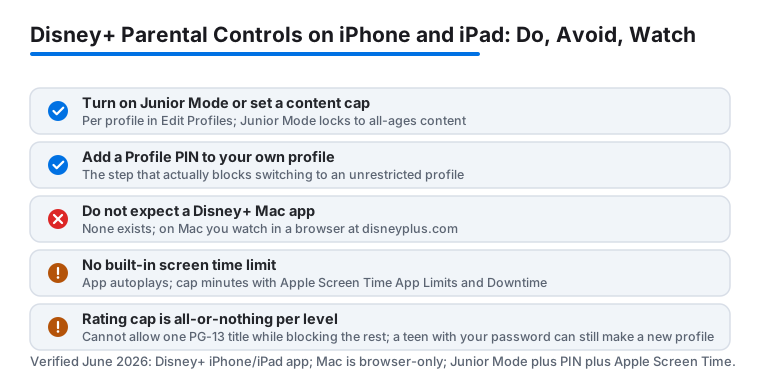
Third, profiles are not bulletproof against a determined older kid who knows your password. The PIN protects profile switching, but a teen with your full login can sign in elsewhere and create a fresh unrestricted profile. For most young children this is a non issue; for a savvy 15 year old it is a real hole, and the fix is account hygiene rather than any Disney+ setting.
Fourth, ratings are Disney's own calls, and now and then we found a title that felt a notch more intense than its label suggested. Treat the controls as a strong filter, not a substitute for the occasional glance at what is actually on screen.
One privacy point worth naming. A child profile still feeds a recommendation and viewing history that Disney associates with your account, and the ad supported plan serves ads against it. The parental controls limit what a child can watch; they do not stop Disney from collecting what was watched. If that bothers you, the ad free plan removes the ads but not the data collection.
Pairing it with the iPhone and good alternatives
The combination we landed on, and would recommend, is Disney+ Junior Mode or a content cap plus Apple's Screen Time. Disney handles what can be watched; Screen Time handles how long. Open the Settings app on the iPhone or iPad, go to Screen Time, and under App Limits you can set a daily cap for Disney+ and schedule Downtime at bedtime. On a child's device managed through Family Sharing you can lock those settings behind a separate Screen Time passcode so the kid cannot raise their own limit. That pairing closes the screen time gap the app leaves open.
If you want tighter control across every streaming service at once, it is worth comparing how the other big apps handle this, because each one names and hides these settings differently. We walked through the same exercise with other services, and you can see how the experience differs in our look at Netflix on iPhone and our guide to getting the most from HBO Max. Each takes a slightly different approach to kid accounts and PINs, and the right pick often comes down to which catalog your family actually watches.
For the wider picture of what belongs on a family iPhone, our roundup of the best streaming and TV apps for iPhone is a good next stop, and you can browse everything we have tested in the Streaming and TV section. For most Disney households, though, the app's own Junior Mode plus a PIN and Apple Screen Time is honestly all you need, and it works the same on the iPhone, the iPad, and a Mac browser because it all rides on the profile.
FAQ
Does Disney+ have a Mac app?
No. Disney does not publish a native macOS app, so there is nothing to download from the App Store for a Mac. On a Mac you watch in a browser at disneyplus.com using Safari, Chrome, Firefox or Edge. The real Disney+ app on Apple devices is the iPhone and iPad app. Any parental control you set carries over to the Mac browser because the controls live on your account, not the device.
Does setting up a child profile on iPhone also protect the iPad and Mac browser?
Yes. Parental controls in Disney+ are tied to the profile and your account, not the individual device. Junior Mode or a content cap you create on the iPhone shows up exactly the same when your child signs in on an iPad, through a browser on a Mac, or on a TV.
Can my child get out of Junior Mode without me?
Not if you have added a Profile PIN to your own profile. With Junior Mode on, leaving it requires an exit challenge, and switching to an adult profile asks for that four digit PIN, so a young child cannot back out into your account on their own. The step that locks switching is setting the PIN on your profile, so do not skip it.
Does Disney+ have a screen time or daily watch limit?
No, there is no time limit built into the app, and it will autoplay episodes indefinitely. To cap how long your child watches, use Apple's Screen Time in the iPhone or iPad Settings app to set a daily App Limit on Disney+ and schedule Downtime at night.
Can I allow one mature title but block the rest at that rating?
Unfortunately not. The content rating is a single ceiling per profile, so it is all or nothing at each level. If you want a child to see one higher rated film, you would have to temporarily raise the cap or watch it together from your own profile.