
Top Benefits of Using Google Authenticator With Your MacBook, iPad, and iPhone
We have leaned on Google Authenticator across a MacBook Air, an iPad, and an iPhone 15 for a few weeks, and the experience taught us something most articles skip: there is no real Mac app, yet it still ended up being one of the steadiest ways we secured our logins. If you keep getting that little six digit code prompt when you sign in and you want to lock your accounts down properly, here is our honest, hands on take on what Google Authenticator does well, how to actually run it next to a Mac, where it frustrates, and what we would reach for instead if it does not suit you.
How it really works with a MacBook
Let us clear up the biggest source of confusion first, because it tripped us up too. There is no standalone Google Authenticator app for macOS. You will not find one in the App Store, and you should be wary of any third party download that claims to be it. We have seen names like G2FA and various emulator tricks floating around, and we would skip them. A handful are unofficial wrappers, and pouring your two factor secrets into an app Google does not publish is a bad trade. The real app lives on your iPhone or iPad by design, since the whole point of two factor authentication is keeping the second factor on a separate, pocket sized device from the computer you are signing in on.
So the workflow that clicked for us looks like this. You are on the MacBook signing in to Gmail, a crypto exchange, or your work dashboard, and the site asks for a code. You glance at your iPhone, open Google Authenticator, and type in the six digits before they refresh every thirty seconds. That physical separation is genuinely a feature, not a limitation. If someone steals your Mac password through malware on the laptop, they still cannot get the code, because it never touches the laptop. In practice it added maybe four or five seconds to a login. The iPad works the same way if that is the device you keep on your desk.
One thing worth saying plainly: the code you read off the phone is not stored on the Mac and is not sent to the Mac by Google. The app on your phone and the website you are signing in to both share a secret that was set up once, and each independently runs the same clock based math to produce the same number. That is why it works with the laptop completely out of the loop, and it is also why your phone has to be nearby.
Getting set up the first time
Installation took us under two minutes. Grab Google Authenticator from the App Store on your iPhone or iPad, open it, and sign in with the Google account you want to use. That sign in step is worth doing, because it turns on cloud sync so your codes are not stranded if you lose the phone. If you would rather not link a Google account, you can use the app without signing in, but then you are fully on the hook for your own backups.
From there, adding an account is the part people overthink. Here is the rhythm we settled into:
- On your MacBook, open the account you want to protect, go to its security settings, and choose to set up an authenticator app. The exact menu name varies, but look for two step verification, two factor authentication, or login security.
- A QR code appears on the Mac screen. On your phone, tap the plus button in Google Authenticator and pick Scan a QR code.
- Point the phone camera at your MacBook display and it captures the code instantly. We linked about a dozen accounts in one sitting this way.
- Type the first generated code back into the website to confirm the link, and that account is done.
If a site will not show a QR code and instead gives you a long string of letters, use the Enter a setup key option in the app and type the string in by hand. One tip from experience: do your most important logins first, email and banking especially, since your email is the master key that can reset almost everything else. And the very first thing you should do after enabling two factor on any account is grab its backup codes, which we will come back to below.
The benefits that actually won us over
After living with it, a few things stood out. The codes work completely offline, which surprised us in the best way. We tested it in airplane mode and the six digit numbers kept rotating perfectly, because they are generated by a time based algorithm on the device rather than texted to you. That makes it meaningfully safer than SMS codes, which criminals can intercept through SIM swapping, where they trick a carrier into moving your number to their own phone.
It is also plain to use. No ads, no upsells, no subscription, just a list of your accounts and their rotating codes. The cloud sync that Google added in 2023 fixed the old headache too, since a lost phone used to mean digging frantically for backup codes. Now your tokens can ride along to a new device through your Google account, and they are encrypted in transit. We also like that there is a privacy step you can turn on, covered further down, that hides your codes behind Face ID. 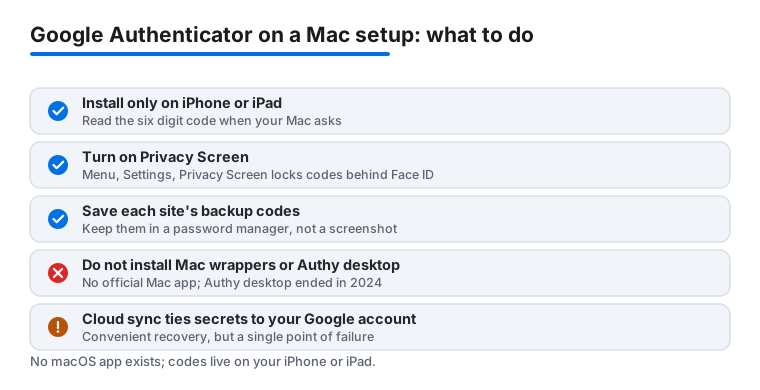
Lock the app and save your backup codes
Two habits made a real difference for us, and both close gaps that older guides get wrong. First, turn on Privacy Screen. Google Authenticator has supported a biometric lock for a while now, and it is genuinely useful, so the claim you sometimes read that the app cannot be locked is out of date. Open the app, tap the three dot menu, then Settings, then Privacy Screen, and switch it on. After that, Face ID or Touch ID is required before your codes show. You can also set how soon it relocks, immediately or after a short delay, which matters if you glance at codes often.
Second, the moment you enable two factor on any account, the site usually offers a set of one time backup codes. Save them somewhere safe, ideally in a password manager, not a screenshot sitting in your photo roll. We treat these as the genuine safety net, because if you ever lose phone access and sync does not bail you out, these codes are how you get back in. Each one works once.
Third, take advantage of the export feature. Google Authenticator can show a special QR code that bundles several accounts at once, reached through the menu under Transfer accounts, which made moving to a new iPhone painless when we upgraded. Fourth, if you keep both an iPad and an iPhone nearby, pick one to be your authenticator and stick with it, since scattering codes across two devices got confusing fast. And while you are tightening things up, it is worth locking down the Google services you already use, which our guide to Google apps privacy settings on iPhone walks through step by step.
The limits and rough edges
We want to be straight with you, because it is not perfect. The most obvious gap is that there is genuinely no Mac, Apple Watch, or browser version from Google, so your phone has to be within reach every time you log in. On the days we left the iPhone in another room, that meant an annoying walk back to grab it. If you sign in from a desk all day, that friction adds up.
The cloud sync, while welcome, is tied to your Google account, so if that account were compromised it becomes a bigger single point of failure. That is exactly why turning on Privacy Screen and using a strong, unique password on the Google account itself both matter so much. There is also a privacy angle worth naming: syncing means your two factor secrets now live in Google's cloud, encrypted, but stored there nonetheless, which not everyone is comfortable with. If you would rather keep secrets only on the device, you can skip signing in, at the cost of easy recovery.
Migrating between an Android phone and an iPhone is clunkier than it should be, and the transfer QR code does not carry every account type cleanly. None of these are dealbreakers for us, but you deserve to know them before committing.
Good alternatives worth a look
Google Authenticator is our pick for most people who want something free and low fuss, but it is not the only option. One correction worth flagging, since plenty of older articles still repeat it: Authy no longer has a desktop app. Twilio shut down the Authy apps for Mac, Windows, and Linux back in early 2024, so Authy is mobile only now. If a guide tells you to install Authy on your Mac, it is out of date.
If you want codes to reach your laptop without walking to your phone, 2FAS is closer to what people imagine. It offers a browser extension for Chrome, Firefox, and Safari that pairs with the 2FAS app on your phone, so when a site asks for a code you click the extension and approve it on the phone. Note that the secrets still live on the phone, the extension just relays the code, so it is not quite a standalone desktop vault, but in daily use it removes the reach for your phone moment.
If you are deep in the Apple world, the iCloud Keychain verification codes feature is quietly handy, since it can autofill your two factor codes right in Safari on the Mac with no separate app, as long as you store the code setup in Keychain when you enable two factor. For folks who want the strongest option, a physical security key such as a YubiKey is the gold standard, though it costs money and is more than most people need. Whichever route you choose, turning on two factor at all is the real win. For the wider shortlist of tools we lean on, browse our Security and Privacy hub.
FAQ
Is there a Google Authenticator app for Mac?
No, there is no official Google Authenticator app for macOS, and you should avoid any third party download or emulator claiming to be one. The app runs on your iPhone or iPad, and you simply read the six digit code from there when a website on your MacBook asks for it. That separation between your computer and your code is intentional and part of what keeps the system secure.
Can I lock Google Authenticator with Face ID?
Yes. The app has a Privacy Screen setting that hides your codes behind Face ID or Touch ID. Open the app, tap the three dot menu, choose Settings, then Privacy Screen, and turn it on. You can also pick how quickly it relocks. This is worth enabling, since without it anyone who unlocks your phone can read your codes.
What happens if I lose the phone with my codes on it?
If you enabled cloud sync by signing in with your Google account, your codes can be restored on a new phone. If not, you will need the one time backup codes each website gave you when you set up two factor. This is exactly why we recommend saving those backup codes in a password manager the moment you turn the feature on.
Do the codes work without an internet connection?
Yes, and this is one of our favorite things about it. The codes are generated by a time based formula running on your device, not sent over the network, so they keep working in airplane mode or with no signal at all. We confirmed this firsthand, and it is part of why the app is safer than text message codes that can be intercepted.
Can I use my iPad instead of my iPhone for the codes?
Yes. Google Authenticator runs the same on iPad, so if that is the device you keep on your desk near your MacBook, it works fine. We would suggest picking one device, either the iPhone or the iPad, as your main authenticator rather than splitting accounts across both, which only gets confusing over time.