
Editing Videos in iMovie on iPad: A Hands On Guide
iMovie is the app most people open first on an iPad, and the reasons are easy to like. It is free, it comes straight from Apple, and it loads without asking you to make an account or sit through a sales pitch. We spent a couple of weeks cutting real footage with it in 2026, from quick camera roll clips to a four minute travel video, and this guide is what we wish someone had handed us before we started.
Getting iMovie running on your iPad
On most newer iPads, iMovie is already sitting on the home screen. If it is missing, open the App Store and search for it. It shows up under Apple with no price tag, no in app purchases, and no subscription waiting to surprise you later. The download is small, and in our testing it opened in a few seconds even on an older iPad Air.
One thing to plan for up front: iMovie is hungry for storage. A single project with a few minutes of footage can quietly swell past a gigabyte while you work, because the app keeps render files and copies of your clips. We learned to clear some space before starting anything serious. We also turned off the iPad auto lock during long sessions, since having the screen dim in the middle of a fine trim broke our focus every time.
The on ramp itself is short. Tap the plus button, choose Movie, and pick clips from your library. That is it. No tutorial wall, no forced tour, no prompt to upgrade. You drop straight into the timeline, which is exactly how a free first edit should feel.
The features that actually matter day to day
iMovie keeps things deliberately simple, and the touch timeline is the part you end up living in. You drag clips into place, pinch to zoom in for finer cuts, and tap a clip to grab its edges and trim with your finger. After about an hour we stopped thinking about the interface at all, which is the nicest thing you can say about an editing app.
A handful of tools earned a permanent spot in how we worked:
- Magic Movie: point it at an album and it scans the footage, finds what it thinks are the strongest moments, and assembles a rough cut with titles, transitions, and music already in place. What surprised us in 2026 is the choice on offer: you can pick from over twenty different styles, each applying its own look for titles, transitions, and soundtrack, so you can flip a vacation reel from clean and bright to moody in a couple of taps. It is rarely the finished video, but as a starting skeleton it saved us real time.
- Green screen: drop a clip shot against a solid backdrop on top of another video and iMovie keys it out cleanly enough that we stopped expecting a free tool to struggle with it.
- Cinematic mode support: footage shot in Cinematic on a recent iPhone keeps its adjustable focus points, so you can change what is sharp after the fact, right inside the edit.
- Built in soundtracks: the royalty free music is genuinely usable, and the tracks stretch or trim themselves to match the length of your edit instead of leaving you to fight the timing.
Titles, filters, and speed controls all sit a tap or two away. None of it is deep, and that is the point. Everything here works without fuss, and for a quick video that is worth more than a long feature list you never touch.
Practical tips from our editing sessions
A few habits made the difference between a smooth edit and a frustrating one. First, pair your iPad with an Apple Pencil, or at least get comfortable using two fingers, because precise trims are far easier when you are not fighting your own fingertip over a quarter second of footage. Second, set your title card and choose your music early. Adding them at the very end means going back and rebalancing audio across the whole project, which is dull work you can avoid.
We also got into the habit of duplicating a project before trying anything risky. iMovie has no real version history, so once you close the app a duplicate is your only safety net. It takes ten seconds and it saved us half a day of work more than once.
On export, match the resolution to your source. Send 1080p for anything headed to social platforms, and reserve 4K for footage you actually shot in 4K. Pushing a 1080p clip up to 4K only makes a heavier file with no extra detail, which we confirmed by exporting both and comparing them. The picture looked identical and the larger file just took longer to upload.
Where iMovie hits its limits
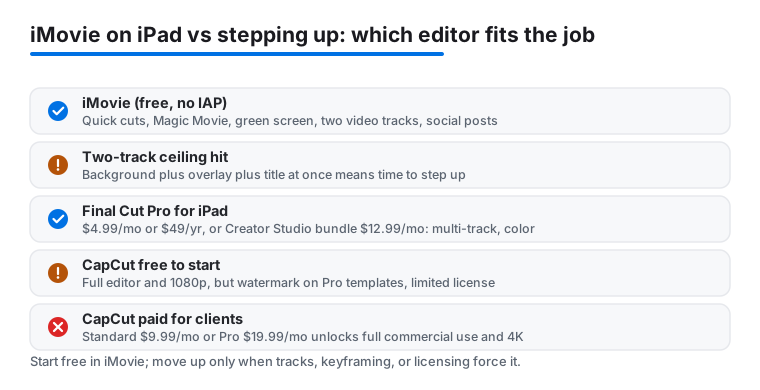
Honesty matters here, so this is where the app frustrated us. iMovie gives you exactly two video tracks. That sounds like plenty until you want a background clip, an overlay, and a lower third title on screen at the same time, and then you hit the ceiling faster than you expect. There is also no keyframing, so you cannot animate movement or opacity over time. A slow Ken Burns pan across a still is about the extent of your motion control.
Color grading stays basic, the audio tools cover little more than fades and volume, and you cannot bring in custom fonts. On a couple of longer projects we also hit a render hiccup where the export bar stalled and we had to close and reopen the app. For casual videos none of this is a dealbreaker. For anything that calls for layered graphics, animated text, or careful color work, you will feel boxed in, and that is the natural moment to look at something with more room.
Good alternatives when you outgrow it
iMovie is a good starting point, and the upside is that the iPad has solid options for the day you need more. If you want professional control without leaving Apple's world, Final Cut Pro for iPad is the clear step up, with multiple video tracks, full keyframing, and a real color tool. The pricing changed in 2026, so here is where it stands. On its own, Final Cut Pro for iPad runs $4.99 a month or $49 a year. In January 2026 Apple also launched the Apple Creator Studio bundle at $12.99 a month or $129 a year, and that single subscription covers Final Cut Pro, Logic Pro, Motion, Compressor, MainStage, and Pixelmator Pro across iPad and Mac. If you were already paying $4.99 a month for Final Cut Pro on iPad, you keep that legacy price for the Creator Studio version, so existing subscribers are not pushed onto the higher tier.
For a lighter option, many editors reach for CapCut. It is free to start and adds extra tracks, auto captions, and a deep effects library, though it leans heavily on its own assets. Worth knowing before you commit: after a 2026 restructure, CapCut now runs three tiers. The Free tier is still genuinely usable, with a full editor and 1080p export, and a manual export carries no watermark. The catch is that a watermark does appear if you keep a Pro locked template or certain AI generated clips, and the free tier only comes with a limited commercial license. The paid Standard plan is $9.99 a month and Pro is $19.99 a month, or about $179.99 a year, and Pro is what unlocks full commercial use for client and ad work plus 4K export. Free is fine for personal posts, but read the license line before you build a paid job on it.
If your videos lean more toward photos, graphics, and quick social posts than long timelines, our guide to creating social media content with Canva on iPad covers a tool built for exactly that. And if look and mood are what you care about most, the techniques in our iPad VSCO walkthrough pair nicely with iMovie for color and stills. For the wider view, browse our roundup of the best photo and video apps for iPad or the full Photo and Video category.
FAQ
Is iMovie on iPad really free with no catch?
Yes. iMovie is free from Apple with no in app purchases and no subscription. Every feature is available the moment you install it, which is still rare for a video editor of this quality.
Can I edit 4K video in iMovie on an iPad?
You can import and export 4K, and newer iPads handle it smoothly. On older models the timeline can stutter while you scrub, so we sometimes edited a 1080p version and exported the final cut at full resolution.
Why does iMovie only give me two video tracks?
That two track limit is a deliberate choice to keep iMovie simple. If you regularly need a background, an overlay, and a title on screen at once, it is the clearest sign to step up. Final Cut Pro for iPad ($4.99 a month or $49 a year, or inside the $12.99 a month Apple Creator Studio bundle) adds proper multi track editing. CapCut is the lighter route, free to start with paid Standard ($9.99 a month) and Pro ($19.99 a month) tiers, though check its commercial license terms before client work.
Will my project transfer from iPad to iPhone or Mac?
Yes. You can send an iMovie project to iCloud and pick it up on another Apple device, or hand it off to Final Cut Pro on a Mac to keep refining. The hand off keeps your clips and edits intact.