
Using Google Chat on Your Mac and iPad: What Actually Works
Google Chat sits quietly inside Workspace, and most people never give it a fair shot. We spent a few weeks living in it across a Mac and an iPad, juggling team threads, shared files, and the odd late night Space full of half finished ideas. The short version: it is genuinely useful for keeping a small team in sync, a little awkward in places, and more capable on a Mac than the App Store screenshots suggest. One thing to clear up before you start, because it trips people up: there is no native Google Chat app in the Mac App Store, and there has never been one. On iPhone and iPad you install the real Google Chat app from Apple's App Store; on a Mac you run it as a standalone window from Chrome. Here is what we learned, the honest way.
Getting it running on a Mac and an iPad
On the iPad it could not be simpler. Search for Google Chat in the App Store, install it, and sign in with your Google or Workspace account. It is a real iPad build and not a stretched phone app, so it uses the wider screen with a conversation list on the left and the active thread on the right. On a 12.9 inch iPad Pro it feels closer to a desktop app than a phone one. The same download serves iPhone and iPad from one universal listing, and as of early 2026 Google had folded its Gemini features straight into this app, so you get conversation summaries, message translation, and smarter search on the tablet without installing anything extra.
The Mac is where people get tripped up, because Google does not ship a native Mac app and you will not find one in the Mac App Store. Anything claiming to be a Mac App Store build of Google Chat is a third party wrapper, not Google's own software, and we would steer clear of handing those your account credentials. The route Google actually supports is to open chat.google.com in Chrome and install it as a standalone window. Sign in first, then look for the install icon in the address bar, or open the three dot More menu and choose Install Google Chat. Give it a name and it lands in your Applications folder and Dock like any other app. From then on it opens in its own window with no browser tabs, no clutter, and its own notification badge. We found this far nicer than leaving Chat buried in a pinned tab you keep losing.
There is one catch worth knowing up front. The standalone Mac app is a wrapper around Chrome, so Chrome has to be running in the background for it to work, even if you never look at a Chrome window. Quit Chrome entirely and the Chat window stops updating. In practice Chrome is open all day on most machines, so this rarely bit us, but it is the reason the app launches a touch slower from cold than something built natively for macOS.
A couple of things to do on day one. Turn on desktop notifications when the browser prompts you, then open Settings and set your working hours, or you will get pinged at 11pm by a teammate in another time zone and that gets old fast. If you want the app waiting for you each morning, you can also set the standalone app to launch at login from its own settings.
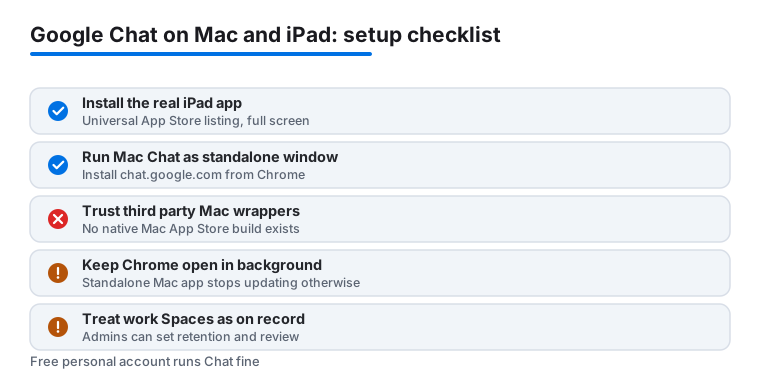
Cost wise, none of this needs a paid plan. A free personal Google account runs Chat fine. Workspace plans add admin controls, longer retention, and the heavier Gemini tooling, but the core of messaging, Spaces, and file sharing is free.
The features that earn their keep
Once you are past setup, a handful of things make Google Chat worth keeping open all day.
- Spaces. These are persistent group rooms for a project or team. The setting worth turning on is in-line threading, where you reply to a specific message and that reply opens its own thread in a side panel instead of dumping into the main flow. A busy room stops turning into one endless scroll, and there is a thread navigation panel that lets you filter down to threads you follow or were mentioned in. Decide on threading when you create a Space, because you cannot freely flip an existing Space between the old flat style and the threaded style later.
- Drive and Docs that just work. Paste a Google Doc link and it expands into a tidy card with the title and a preview. Share a file and permissions are handled for you, so nobody hits that request access wall mid meeting.
- Search that finds things. Search is the whole point of Google, and it shows. We pulled up a six week old message about a billing change in seconds. On both the Mac app and the iPad, Gemini now sits behind search and can answer in plain language, though it leans on your account having the relevant Gemini features switched on.
- Quick meetings. Jump from a thread straight into a Google Meet call without copying links around. On the Mac standalone app the call opens in the same window, and on the iPad it hands off to the Meet app cleanly, so you do need Meet installed there for the smoothest experience.
- Reactions and status. Small, but a thumbs up beats five people typing sounds good one after another, and a status note saves a round of where are you messages.
The Gemini layer is the newest piece and the one to be a little careful with. Conversation summaries and translation across a long list of languages are handy when you come back to a noisy Space, but anything AI generated is worth a quick read before you act on it. Treat a summary as a starting point, not gospel, and remember that on business plans your admin controls whether these features are on at all.
Practical tips from weeks of daily use
A few habits made the whole thing noticeably calmer. Star the two or three Spaces you actually care about so they float to the top and the noise stays out of the way. Mute the ones you only need to skim, since a muted Space still shows unread counts without buzzing your Dock.
Learn a couple of keyboard shortcuts on the Mac and you stop reaching for the trackpad. Press the question mark, which is Shift and the slash key together, to pull up the full shortcut list any time. To start a new conversation or jump to one, press Command, Shift and k. Inside a threaded Space the arrow keys move you around: right arrow steps into a thread's replies, left arrow takes you back to the message that started it, and up and down move between messages. These are small things that add up over a day.
On the iPad, pair it with a keyboard and it becomes a real second screen for chat while you work on the Mac. We often kept the iPad propped to the side running Chat in Split View next to notes, which left the Mac free for the work that needed focus. Threads sync across both devices, so you can start a reply on the iPad, walk to your desk, and finish it on the Mac without losing your place. That quiet continuity is the thing that sold us more than any single feature.
One privacy note worth saying plainly. On a Workspace account, your organisation's admins can set retention rules and, depending on the plan, review message content for compliance. Chat is not a private back channel from your employer. For genuinely personal conversation, keep it on a personal account or a different app, and assume work Spaces are on the record.
Where it falls short
It is not all smooth. The biggest catch is that Google Chat wants you inside the Google world. If your team lives in Slack or Microsoft Teams, Chat feels like an island, because there is no easy bridge between them and no decent way to mirror conversations across platforms. We also missed richer message formatting. You get bold, italics, strikethrough, bullet lists, and a basic code block, but nothing close to what a developer focused tool offers, so sharing formatted code or tables is clumsy.
The lack of a true native Mac app is a real, if minor, downside, and it is worth repeating since the page title might suggest otherwise. The standalone install is good and behaves much like a native app, yet it is a Chrome wrapper underneath. That means it launches slower from cold, it depends on Chrome being installed and running in the background, and it will never feel quite as snappy as software written for macOS directly. On the iPad, very large Spaces with a lot of media occasionally felt sluggish to scroll on older hardware. None of this is a dealbreaker for everyday team chat, but go in knowing you are not getting a polished standalone Mac product from Google.
The Gemini features are also uneven. They are genuinely helpful when they work, but availability depends on your plan and region, summaries can miss nuance, and on a free personal account you may not see the same tools your work account has. If those AI extras are the reason you are choosing Chat, confirm they are actually on for your account before you commit a team to it.
Good alternatives if Chat is not your fit
If Google Chat does not click, you have solid options depending on where your team already lives. Microsoft Teams is the natural pick for anyone deep in Office and Outlook, with heavier built in calling and file collaboration. Slack remains the favourite for fast, channel based chat with a large library of integrations, though the free tier limits how far back your message history stays visible. If your main need is meetings rather than messaging, Google Meet covers video well and still ties back into the same Workspace account.
For a wider look at what we rate across the category, browse our best productivity apps for Mac roundup and the full productivity hub. The honest answer is that Google Chat is the right call when your team is already on Google. If you are, it is a quiet, reliable place to keep everyone talking, as long as you go in clear eyed about the Chrome wrapper on the Mac and the genuine iPad app on tablets.
FAQ
Is there a real Google Chat app for Mac?
No, there is no native Google Chat app in the Mac App Store, and Google has never shipped one. The supported way to run it on a Mac is to install chat.google.com from Chrome as a standalone window, which gives it its own Dock icon and notification badge. It works well, but it is a Chrome wrapper, so Chrome must stay open in the background.
Is the iPad version a real App Store app?
Yes. Unlike the Mac, the iPad and iPhone get a genuine Google Chat app from the Apple App Store under one universal listing. It is a proper iPad build that uses the full screen, signs in with your Google or Workspace account, and includes the same Gemini summary and translation features that rolled out across the apps in early 2026.
Do I need a paid Google Workspace plan to use it?
No. Google Chat works with a free personal Google account as well as paid Workspace plans. Some admin, retention, and Gemini features only appear on business plans, but everyday messaging, Spaces, and file sharing are open to everyone.
Does it sync between my Mac and iPad automatically?
Yes, and this was one of its strong points for us. Sign in with the same account on both and your conversations, read state, and drafts stay in sync, so you can start a message on one device and finish it on the other.
Can I make video calls from inside Google Chat?
You can. Any conversation has a meet option that launches a Google Meet call without copying links around. On the Mac standalone app it runs in the same window, while the iPad hands off to the separate Meet app for the call itself, so it helps to have Meet installed there.